
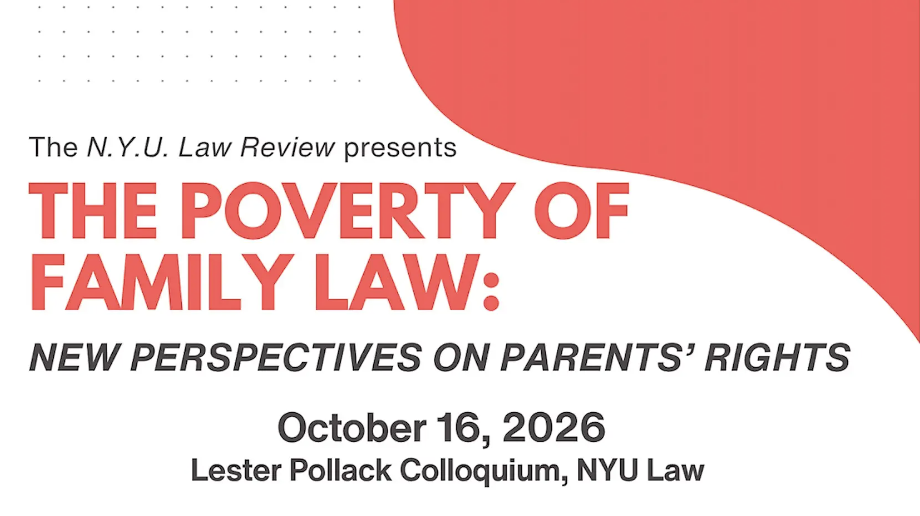
This event is hosted by New York University Law Review.
There has long been a deep race and class divide in family law between “private” family law (read white, affluent families) and “public” family law (read economically disadvantaged and nonwhite families). The former dominates scholarship, along with pedagogy and advocacy, whereas the latter is discussed, if at all, mostly in clinical and poverty law scholarship. This divide puts many marginalized families and parents—affected by poverty, race, disability, immigration status, etc.—on the “public law” side, the ignored side, while the standard white, middle-class, heterosexual “American family”—about which most law students learn, on which policymakers focus, and which is legible to the public—holds the side with more access and resources.
The family law divide is not a new phenomenon. Nonetheless, its consequences are increasingly salient, for it has real and meaningful effects on families and the people in them, on the law itself, on law reform efforts, and on the ability of policymakers to achieve meaningful change.
Hosted by the N.Y.U. Law Review, The Poverty of Family Law symposium seeks to address this divide. Bringing together scholars, practitioners, and community activists in different (and often siloed) legal fields, we aim to move beyond the academic conversation to one that tackles questions of sociological change. In particular, we will discuss gaps and disparities in family law scholarship and in the family law system, missing voices in the family law legal curriculum, the interplay between culture wars and democratic projects on parenting, and visions for the future.